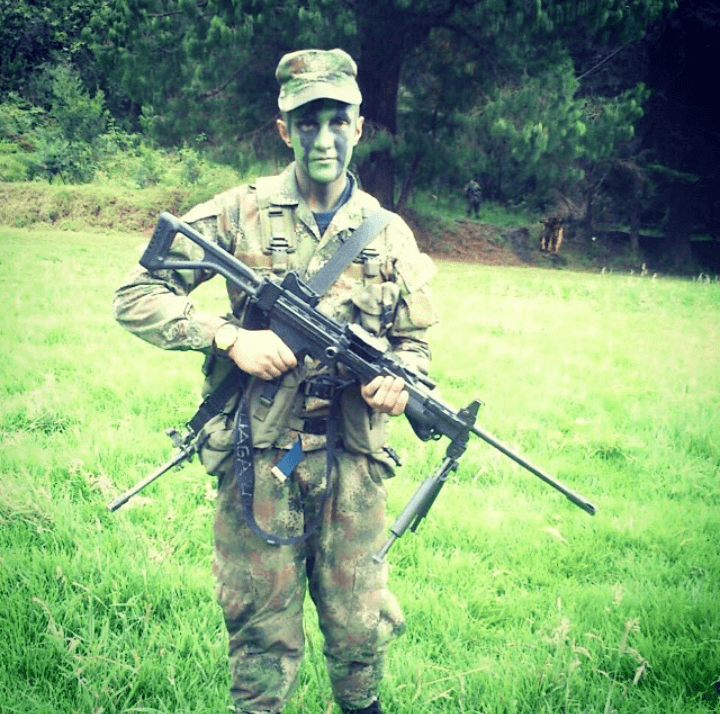
I was a soldier, and back then they asked me a question: “Would you put your chest in the path of bullets that aren’t meant for you?” Without hesitation, I said no, and I still feel the same way—except that six years later, I understand the reason behind my answer much more clearly.
Every time I put on my camouflage, loaded my rifle, and went out on patrol, I’d think: “What if today I have to shoot the ‘enemy’?” My ethical and moral reasoning was severely challenged, because I realized that he didn’t know me and I didn’t know him; that he hadn’t done anything to me, nor I to him; that I didn’t even know which soccer team he rooted for, nor did he know which team I supported—and yet I still had to kill him if I saw him, because otherwise he was going to kill me.
In Colombia, talking about the armed conflict is as normal as talking about Netflix series; although, come to think of it, any armed conflict is normal anywhere—what’s unusual is talking about peace. Here, being a pacifist is very dangerous because that ideology is grounds for being murdered. Pacifists are commonly called “social leaders.”
Humankind has been at war for so long that, if we add up the time we’ve lived in complete peace, it would amount to less than a quarter of human history. If war is normal and peace isn’t, what’s going on?
In his controversial book Mein Kampf, Hitler said that when reason cannot prevail, violence does so more easily—and that makes sense; no one can engage in dialogue with a dead person. The problem is that we’ve grown accustomed to violence; for example, it’s common to assume that dissidents are killed, which is why no one speaks out—for fear of meeting a fatal end.
It is much harder to build than to destroy; likewise, it is much harder to sit down and talk with the opposing side to find common ground than to simply round up and execute that same opposition. The problem would cease to be so critical once we can recognize in each other’s eyes the shared humanity we all possess—neither inferiority nor superiority—but rather become capable of acknowledging others’ differences and accepting that, quite simply, no one is exactly like anyone else.
My story—and that of every other human being—is different. My sister and I, even though we’ve lived together and are physically alike, have different ideologies, and that’s okay, because her point of view complements mine, and vice versa. No one is capable of seeing the full picture of reality; that is why we always approach problems from a single perspective—our own.
A while back, I read Hermann Hesse’s Steppenwolf; there’s a passage in it that goes something like this: “We human beings should act as mirrors to one another—not to see similarities, but to see differences.” If everything were like that, wouldn’t society be much more tolerant?
Dialogue is the most powerful tool we humans possess; no other animal species is capable of reasoning and self-development at the level that we humans do. But at what cost did we acquire such a faculty if we’re constantly in conflict?
My faith in humanity is restored by Gandhi, Martin Luther King Jr., Thoreau, and many others who have demonstrated that nonviolence is superior. These are people who have dared to think outside the box, as Giovanni Stella, the current CEO of Google, puts it. Having the guts to go against all odds—and against the prevailing ideology of their respective times and places—is something everyone should value. The dark side of this is that they share something in common: the vast majority of them were assassinated—but that’s normal. It’s just considered normal for pacifist leaders to be killed.
Even though their stories end in tragic outcomes, I believe their example is enough to make us believe that problems can indeed be solved without resorting to death or hatred; we just have to set aside the notion that it’s impossible to break free from the cycle of war.