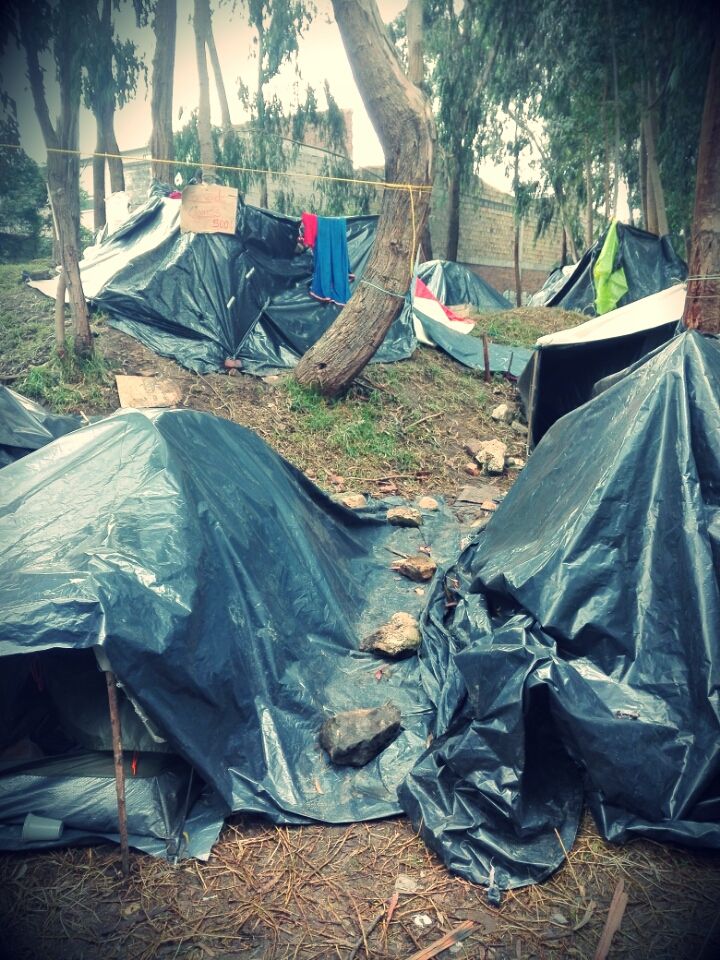
Last Saturday, September 15, I went with some classmates from the university where I study to a temporary camp for Venezuelans located near the Salitre terminal in Bogotá. It wasn’t until that day that I learned there are several camps like this one.
Frankly, it was a difficult experience for me; having to witness the conditions in which other human beings live—people who laugh, cry, and feel just like anyone else—and knowing that they are not to blame for their situation is hard.
The purpose of the visit was to bring them chocolate and sandwiches—an activity we call “Chocolate in the Park,” since we do it often, though usually with the homeless people in downtown Bogotá.
I wanted to find someone who could tell me firsthand about the situation in his country amid the economic crisis Venezuela is currently facing, and I had the opportunity to interview Martín José Gregorio Martínez, a Venezuelan who recently arrived in the city and kindly agreed to help me with this interview.
How long have you been here (in Bogotá)?
I left Venezuela about six months ago; I was in the Urabá area, in Apartadó. I’m an electrician, and when I realized I wasn’t making good wages, I decided to come to Bogotá twenty days ago, and so far I haven’t found a job.
How long did you live in Venezuela?
My whole life. I’m 49 years old.
Given that people have been emigrating from Venezuela for quite some time now, what made you decide to come?
Well, primarily because I no longer had a steady job, and I had a small farm that provided enough to support myself; it was enough to support me, but not enough to support my daughter, who is studying medicine, so I decided to come here to find better income so she can finish her medical degree. She still has one year left.
Is she here too?
No, no, she’s back there finishing up.
What degree programs are people currently pursuing?
There’s still medicine, economics, nursing… and the government pays for them, but there aren’t many spots available. Plus, the quality of education has declined significantly because the good teachers have emigrated to other countries. Under Chavismo, we have “kids” who study two hours a day and graduate from high school in two years; it’s not like when we used to study for five years in high school—although I studied for three years and then got a technical degree at an INCES, which is kind of like SENA here. I studied a technical program in high-voltage electrical lines, and in the third year, you became a technician.
What is INCES?
Kids would graduate from there as welders, electricians… and it was great, but the government shut it down; now it’s all politics.
Did you come here alone or with family?
Alone.
And how many people are in your family?
Three children, my siblings, and my nieces—I help whoever I can. If someone is sick and they call me, when I have the means, I send them money.
Tell me a little about the transition you’ve experienced—for example, who was in power before Chávez? Or what do you remember about previous governments?
I’ll tell you something: people used to say the previous governments were bad, but I lived through several of them. The late one—the one who died (Hugo Chávez)—raised a generation of young people whom he began to give handouts to, and that made them “lazy.” Our generation, the one before, were the workers. Back then, people in Venezuela paid for electricity, water, and so on. When Chávez came along, people stopped paying for electricity and water, and they got used to that (as you say). So today’s young people are given scholarships for studying, scholarships for raising children—they’re given scholarships for everything—and that’s why the Chavista youth are lazy.
What do you remember from before Chávez?
Carlos Andrés Pérez was in office. He was a president who was overthrown because he raised the price of gasoline by one real—they staged a coup against him. After him came a president who united all the parties (Rafael Caldera), and he won; he granted Chávez a pardon (for his coup attempt), but Chávez should never have been released—he should have died in prison; otherwise, Venezuela would still be in good shape.
Economically speaking, how far did your money go back then?
I worked at one of the best electricity companies; I worked at EDELCA. With my salary, I could buy two boxes of groceries, and I had farmhands working for me. I’d bring food for myself, my mom, and the farm; I had money left over to take my kids out for pizza, take them to Margarita’s beaches in December, and pay for a ten-day vacation at a beach house; and nowadays, you can barely afford to eat. The salary there is enough for a chicken or a carton of eggs—that’s all I’m saying.
But how does the minimum wage compare then and now?
I used to earn three times the minimum wage, but even someone earning the minimum wage could put food on the table and eat well.
What do you think of the opposition?
I think the opposition is a smokescreen—as we say plainly—because they’re the same people; they pay the opposition. Since the government has so much money, they pay the opposition to act like an opposition, but in reality, there is no opposition.
What do you think of the recent reelection?
A smokescreen. A sham. There was no opposition there—I mean, there was no opposition candidate; he (Maduro) knew he was going to win. And how could he not win when they control the National Assembly, which does whatever they say; they control the Supreme Electoral Council; they control the TCJ (Citizens’ Court of Justice); all branches of government are theirs, and no government had ever held that much power before—it used to be shared—but today they hold it all. So there’s no way out there; I’ve never seen anyone win a lawsuit against the government; and I’ve never seen anyone from the government go to prison either; the generals are the biggest drug traffickers.
So, is the corruption of power very obvious?
Of course, because if they lose power, they’ll go to prison: for being criminals, for being drug traffickers, for the people they’ve killed—for everything. The students got fed up; they were killing a lot of them.
Do you think there are people who support them (Maduro)?
Yes, there are. The people who have enough to eat, in the community councils, the slackers who are content with that stipend they give out. People who also have up to four kids and are told, “You have to go to a rally”—of course they go. They won’t sell me food because I’ve never voted for them; I’m kind of like an opponent.
When the army was killing members of the opposition—because that was in the news—what’s your take on it? What did you hear about that?
Since the military and the government are theirs… Here in Colombia, military personnel don’t vote, but there they do. The soldiers dress in red; they’re Chavistas. They use a salute with the phrase “homeland or death” and “we’ll live forever with the homeland,” which is the slogan of socialism. So I see that the military is on their side; they’re like government employees.
Do you think there will be a quick solution to this problem? Or what do you think should be done to resolve it?
First and foremost, I’d say… Socialism doesn’t exist. As for there being equality—no, that won’t happen. What is equality? The wealthiest surnames I’ve heard in Venezuela were Capriles, Cisneros, Radosquin, Gonzalez—people like that. Now you hear about the Cháveses, the Diosdados—because Diosdado was a poor lieutenant, and now he’s one of Venezuela’s biggest millionaires… They talk about “equality,” but they eat well while children die of hunger every day; you see people dying in hospitals—equality doesn’t exist.
How do you think a positive transition could happen? And what do you think that positive change would look like?
I imagine that if we uproot that government completely, it would take at least eight years. I won’t live to see it, but my children and grandchildren will. When companies start coming back to invest as they did before—what Chávez did was drive out every company he could, and the ones he couldn’t drive out, he didn’t just take over—he bankrupted them to keep the people submissive; But if there’s a way, I believe that once they’re gone, people will start investing again because, for example, there are people here with a lot of money who know that Venezuela has abundant mineral resources. I don’t mean to belittle you, but we’re richer in minerals—even with poor management.