It's been a long time since I last wrote—I've been going through a period of stepping back from it all. I think this is a good time and a great opportunity to start writing again—to write about what’s happening in my country and in Latin America in general. Ordinary people, people like you and me, are fed up with so much corruption, inequality, and injustice. It’s our leaders who should be working to ensure equity for the people of a nation.
In Colombia, the strike has certainly given people plenty to talk about. As of today, it has been going on for seven days, and there’s no precedent for this. It’s the first time in this country’s history that we’ve seen demonstrations of this nature.
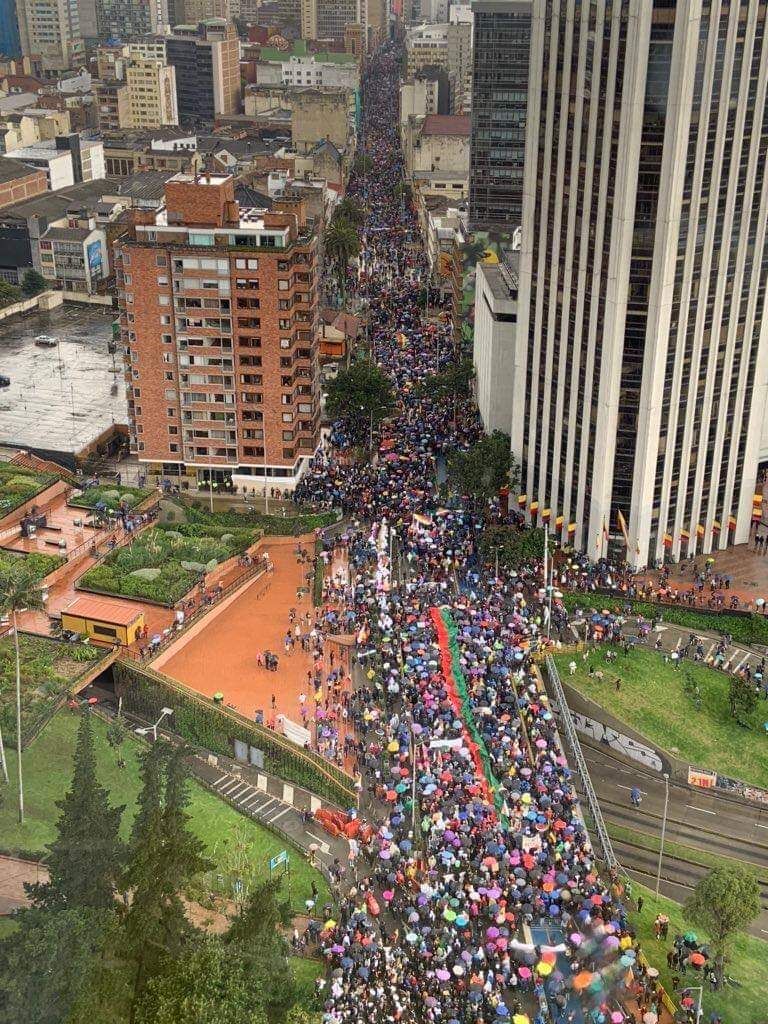
In general, it has become clear that we are not united; polarization is evident in the fact that there are so many political parties, so many ideologies, and ways of thinking—and that’s not a bad thing. The problem is that we’re used to attacking one another: that the people over here don’t get along with the people over there, that the people over there are fat, that those people are idiots, fascists!, guerrillas!!… It almost seems like a contest to see who treats whom worse.
The problem lies in politics—in the very same dispute we’ve always inherited between the left and the right. I’m going to be blunt about my point of view: We can take a political stance without having to attack those who represent our opposition like rabid dogs; the left-right divide has already been severely distorted and is now just a tool used by those in power to keep us divided.
The thing is, we don’t easily realize it, but as I said, we’ve inherited this sense of obligation to adopt a political position and, by extension, to attack whoever is on the other side of the spectrum. But why does it have to be that way? In practice and in real life, there is more than one axis; there is also up-down, forward-backward, and an infinite number of axes that shape our reality. Assuming that there is only a single axis (the usual one) limits our ability to interpret reality correctly. It’s like looking through glasses that only let you see a single color; you’ll be able to see all the nuances and shades of that color, but by ignoring the rest, you won’t be able to appreciate the contrast that arises from the combination of all colors. You’ll lose the ability to appreciate beauty and, more importantly, you’ll lose the ability to critically interpret reality.
And of course, from each person’s point of view, everyone is right. It is impossible to interpret the reality that affects us all from a single point of view. For this reason, I feel it is necessary to move away from that model of doing politics.
Leaving aside the left-right issue for now, I’ll return to the point I mentioned at the beginning. It turns out that in the context of the national strike, there are many people who believe the strike is illegitimate—and not only that, but they attack and stigmatize anyone who does support the strike. The issue isn’t just that; those who do support the strike are also against those who aren’t taking a stand on the matter. One side against the other—what a strange situation…
The context is that the current government is openly right-wing, and those who elected Iván Duque (the current president) last year are the ones who mainly disagree with the national strike—and I think it’s already clear why they disagree.
The main reasons given by those who called for the strike and support it are as follows:
- The “package of reforms”: Labor and pension reforms that would primarily affect younger generations.
- Education: Since last year, there have been demands for more investment in education for the least privileged (the government has been very negligent in this regard).
- The killings of Indigenous people, social leaders, and demobilized former guerrillas. Essentially, the return of violence and a sense of insecurity.
- Failure to comply with the peace agreement: There is a noticeable lack of commitment on the part of the government to uphold the agreements reached with the now-defunct FARC, which is currently a political party.
- The recent bombing and massacre of approximately 18 minors, presented as war casualties (casualties deemed valid within a war context according to the state).
- Privatization: There are several state-owned companies that the government intends to privatize.
Regardless of whether or not you support the strike, don’t you think a government should ensure the above points are addressed without having to resort to a strike? The fact is that, in short, the discontent stems from the fact that this government does not govern for everyone, but only for a select few. In fact, it governs only for those who represent productivity for the nation, and if that is not the case, that is how it is perceived.
The only ones benefiting from the government’s current policies are the same wealthy class as always. That class has left us mired in inequality. I am not making this claim without basis: GDP per capita to date is €5,624, approximately 21,745,814 pesos (source: https://datosmacro.expansion.com/pib/colombia), a figure that does not reflect reality, because less than 1% of the total population earns that much or more.
The current protests aren’t being led by people on the left. They’re the result of people who are tired of working their whole lives for a pittance that doesn’t go far because everything is so expensive. Anyone who genuinely wants to bring about change is silenced, and anyone who wants to study has to earn more than they hope to make just to pay for their education—or work themselves to the bone while studying at the same time. Added to all this is corruption. It is our political leaders who have brought us to this state. They neither act nor allow others to act.
The discontent is already more than evident, and I don’t know what would have to happen for real measures to be taken to put a stop to this situation. We must take action; those of us who have the opportunity to get ahead have a responsibility to advocate for change on behalf of those who have the least.