On October 10, a very important event took place in the city—in fact, it was a nationwide event: a student march. I was there, along with many acquaintances I never thought I’d see at something like this—the vast majority of whom were from my university. It was gratifying to see firsthand how an entire class—the student body—came together to protest. The whole city came to a standstill.
The context is as follows: The current administration, which took office on August 7 of this year, has implemented a rather controversial government plan; Recently, the General National Budget (PGN) for 2019 was being debated; among other things, it has already been approved in the first reading in Congress. However, the budget is the subject of criticism because it allocates 25% of the nation’s total wealth to defense.
The measure was heavily criticized because allocating those resources would mean cutting investments in education and research. Therefore, I felt it was my duty as a student to go out and protest.
The idea is to support public education, which is the right path to providing quality education to the population, rather than relying on “pilo paga”—an excellent initiative, but an insufficient one.
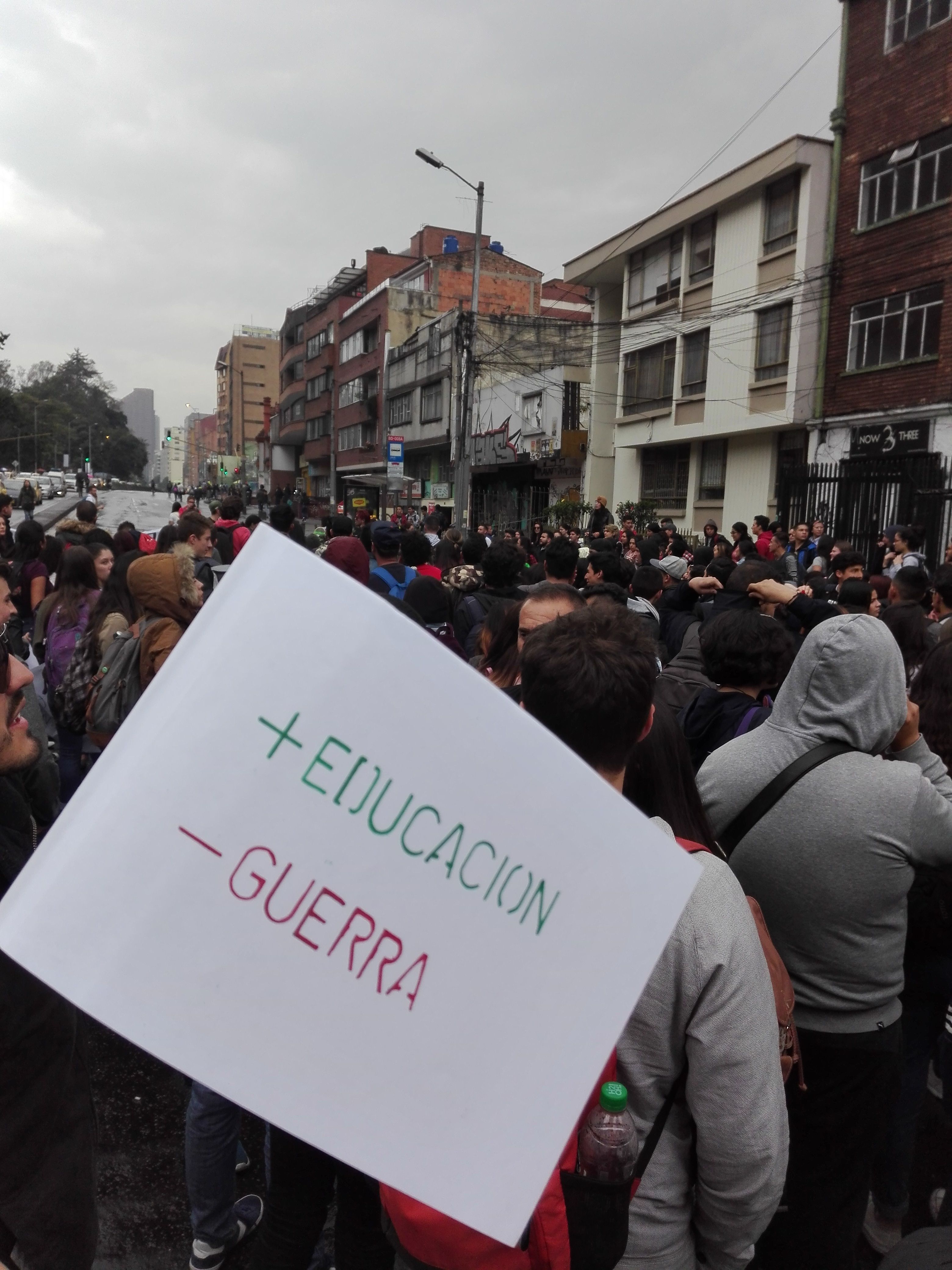
Around noon, we set out along the entire length of 7th Avenue, heading toward Bolívar Square here in Bogotá. Along the way, we joined up with other groups of protesters from different universities, and the crowds kept growing larger and larger. Other universities were also joining in along the route; I saw rivers and rivers of people—it was impressive to see the sheer number of people who turned out.
This is the second time I’ve been to a protest like this; the first was the vigil for the murdered social leaders (which, come to think of it, I should write an account of that day). This time, I felt a completely different atmosphere—full of energy and vigor. People were outraged; at the vigil, they were emotional.
I remember we were chanting something like, “Where is the USTA? Where is the USTA? The USTA is here, making its voice heard.” Singing that in unison at the top of our lungs made you shout as if from the soul, and it was even more powerful to see classmates who are normally very shy completely let loose—they really didn’t care what anyone said to them; we all felt the same way.
Those of us from the USTA sang the chants of the La Salle group; the La Salle students sang the USTA chants; we all sang along with the SENA students—who were in the minority—and everyone present felt we had power, which we expressed by chanting at the top of our lungs.
The march was quite long, which is why public transportation and other businesses had to suspend operations until the march was over—I’d say everything was at a standstill for at least six hours. This whole scene got me thinking.
Historically, mass demonstrations have achieved significant results, such as the repeal of unjust measures, the overturning of inequitable laws, and even political reforms. That’s why student marches are so important—because in every country where a march of this kind has taken place, it’s well understood what kind of power the student body wields in society.
We must assert our right to protest peacefully more often; in these events, one realizes the importance of working as a team and that the people will always outnumber the ruling class. It is not in the ruling class’s interest for students to take direct action against them, because students are literally the group best suited to put an end to the mafia-like structures they have created. The problem is that many people haven’t bought into this idea yet; not all students marched, and many still live with a certain degree of submission.
That’s why I say we have to break the mold; we have to dare to step out of our comfort zones and take a critical, unflinching look at the reality of Colombia. Many continue to view the world through social media, deliberately ignoring the pain and suffering experienced by the lower classes.
War, as I’ve said before, makes no sense. There is NO logic that justifies sending so many young people to fight guerrillas when we could benefit more from them by educating them and equipping them with valuable skills. That isn’t achieved by teaching them how to handle firearms.